
幻夜
China-made EVs win a growing number of European consumers, despite EU’s levying unfair tariffs_我的网站

A | "For decades now, the Pacific Ocean can be fairly described as an American lake, in which the US strategic presence is actively supported by the Australian and to a lesser extent New Zealand economic and security presence," says Joseph Camilleri, emeritus professor at La Trobe University in Melbourne.,However, with the People's Republic of China's (PRC) swift economic rise, it's hardly surprising that Beijing has started to explore new possibilities in the Pacific, according to the academic.,"What has particularly troubled the United States and its principal ally in the South Pacific, Australia, is the fact that China is making inroads into what was until now considered to be an exclusive American sphere of influence," he stresses.,On July 13, Vice President Kamala Harris told the Pacific Islands Forum (PIF) in Suva in a virtual address that US funding for the region would be stepped up to $60 million per year for 10 years. The newly announced endeavor includes more funding for fisheries, extra aid, and offers of new US embassies in the Pacific. In particular, the US is set to ink renewed fishing treaties with Pacific island nations allowing US vessels to fish in their exclusive economic zones (EEZ), and offering greater support for maritime surveillance in the Pacific. In addition to that, the Peace Corps – the United States government's volunteer program – will return to four countries, including Fiji, Tonga, Samoa, and Vanuatu, according to CNN.,Australia Welcomes 'Renewed Commitment' From US Towards Pacific, Willing to Work With China11:38 GMT,"The timing of the pledge has much to do with the strategic competition between the United States and China," Camilleri explains. "In recent years, China has made considerable headway in developing its relations with [the Pacific Island Forum (PIF)] board, including cooperation in political, security and regional affairs, aid and development, COVID response and health, Ocean affairs and climate change, and much else.",The US attempt to assert its presence in the Pacific region also comes on the heels of the Quad IUU Fishing Initiative announced in late May, according to Jay Batongbacal, director of the University of the Philippines Institute for Maritime Affairs and Law of the Sea.,The leaders of the Quad nations — Australia, India, Japan, and the United States – proposed a maritime surveillance initiative to establish a tracking system to combat illegal, unregulated, and unprotected (IUU) fishing. The Quad endeavor may be viewed as an extension of earlier initiatives against China's fishing activities in the South Pacific, according to the academic.,"The South Pacific region is presently one of the richest and most active fishery areas in the world," he highlights.,Why Asia Won't Reject Russia's Hydrocarbons or China's Rare Earths Despite US PressureYesterday, 18:54 GMT,Even if Half of Pacific Islands Ink China Pact, It'll be Beijing's Win,Two months ago, Beijing offered a draft agreement between China and 10 island nations spanning policing, security, fisheries, data, and a free trade zone. Some Pacific leaders have agreed to consider China's trade and security pact, while the others have voiced concerns that their rapprochement with Beijing could antagonize Washington.,"The Chinese proposal to establish a China-Pacific Islands cooperation framework agreement may not yet have won sufficient support but I expect that the Chinese side will persist with its proposal, and that it may be happy to proceed with it, even if only five or six Island states are prepared to sing such an agreement," says Camilleri.,Prior to that, in mid-April, the Chinese and the Solomon Islands governments formally signed a bilateral security agreement regardless of the displeasure voiced by the US, Australia, and New Zealand. Commenting on the pact on June 3, State Councilor and Foreign Minister Wang Yi underscored that its purpose is "to assist the Solomon Islands in maintaining social order." He vehemently denied Western media speculation about China's apparent plans to beef up its military presence in the region.,"China has come to the South Pacific region to build roads and bridges and improve the people’s lives, not to station troops or build military bases," Wang highlighted.,© MANDEL NGANUS President Joe Biden meets with China's President Xi Jinping during a virtual summit from the Roosevelt Room of the White House in Washington, DC, November 15, 2021. US President Joe Biden meets with China's President Xi Jinping during a virtual summit from the Roosevelt Room of the White House in Washington, DC, November 15, 2021. © MANDEL NGAN,US-China Competition for Pacific Islands Region Will Intensify,As the US and China's competition for the resource-rich region unfolds, it all depends on what Washington and Beijing can offer to Pacific island nations, according to Camilleri.,"It is doubtful that the paltry sum of $60 million offered by the United States can even begin to match what China is offering, or that it will greatly impress the Pacific Islands States meeting in Fiji," the professor suggests.,Furthermore, China has made substantial progress in building trade relations with the countries of the region as well as in establishing diplomatic ties with the PIF. The People's Republic was first invited to attend the PIF-related Talk on Establishing Dialogue Partnership held in Suva, Fiji, in 1988. Since 1990, China has attended the Post-Forum Dialogue meetings on a regular basis. In 2003, China announced its willingness to further expand economic ties with PIF member countries as well as to provide funding for the forum's secretariat.,"According to official Chinese figures, from 1992 to 2021, total trade volume between China and Pacific Island Countries (PICs) having diplomatic relations with China grew from $153 million to $5.3 billion, registering an average annual increase of 13% and expanding by over 30 times in 30 years. Similarly, by the end of 2021, China’s direct investment in PICs having diplomatic relations with China had reached $2.72 billion," says Camilleri.,The competition between the United States and its allies on the one hand and China on the other will, if anything, gather pace and intensity in the years to come, the professor says, adding that Beijing's advantage is that "it comes to the table with a much bigger checkbook, and greater opportunities for trade and investment, especially in infrastructure projects."。
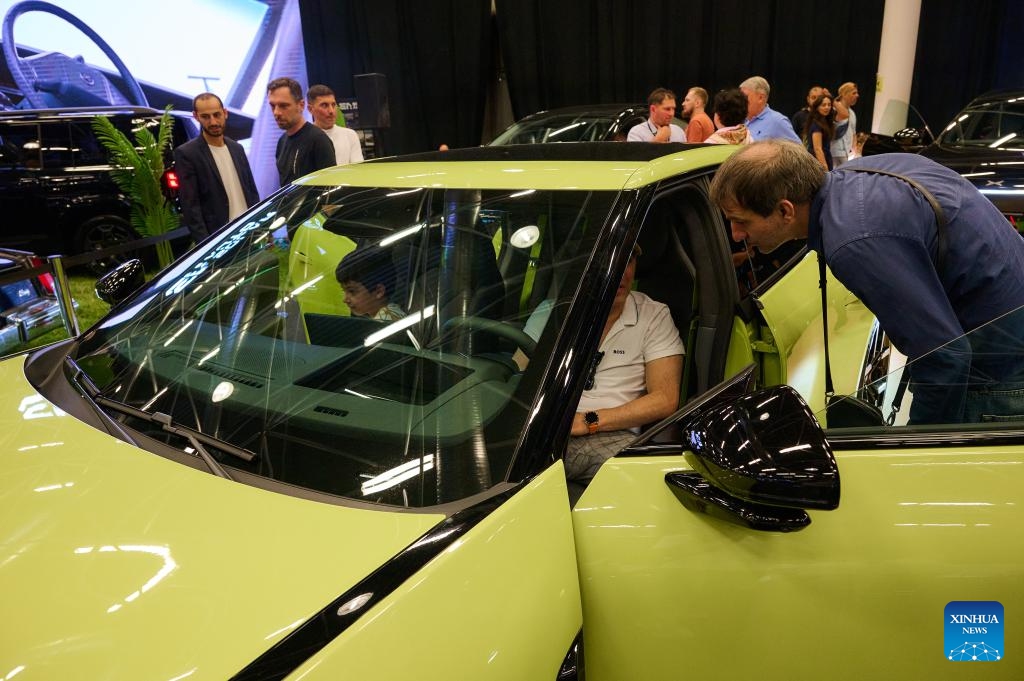
China-made electric vehicles (EVs) accounted for 14.2 percent of European market sales in the first five months of 2026 despite the EU's steep tariffs. The growth showed that trade‑protectionist barriers can only serve as short‑lived obstacles, as consumers' purchasing choice ultimately hinges on product competitiveness and China's EV strengths will support the automakers' long‑term growth, Chinese experts said.
The market share of electric cars sold by Chinese companies rose to 14.2 percent in European market in the first five months of this year, according to Schmidt Automotive Research. The 171,800 EVs sold there represented an increase in market share of five percentage points from one year earlier, the Guardian reported on Sunday.
The increase in European sales comes despite EU tariffs of up to 35.3 percent for EVs made by some Chinese manufacturers, on top of the standard 10-percent import duty. The UK is the largest European market for Chinese cars because London has declined to follow the EU's lead in imposing more levies. The UK accounted for a quarter of Chinese EV sales in Europe, according to the report.
Cui Dongshu, secretary-general of the China Passenger Car Association, told the Global Times on Monday that the surge showed trade protectionist policies have failed to contain Chinese automakers' overseas expansion.
Chinese EVs enjoy "a generational edge" over Europe's legacy carmakers. Their overall product strength remains the primary reason behind their popularity among European buyers, Cui said.
Meanwhile, fluctuating global oil prices have pushed up driving costs throughout Europe, fueling demand for affordable electric vehicles, a need well‑met by the affordable Chinese‑made models. Meanwhile, the gradual return of European electric‑vehicle purchase subsidies has lowered purchase barriers and lifted total EV sales, which has in turn worked to the advantage of Chinese exporters, Cui Dongshu said.
Chinese brands expanded their market share in Europe in the first half of 2026 driven by local subsidies and higher oil prices, Fitch Ratings said in a report sent to the Global Times.
The combined market share of leading Chinese brands in the EU, European Free Trade Association and UK rose to 11 percent in the first half of this year, up from 7 percent in the first half of 2025. The largest Chinese players, Geely Group (including Volvo Car) and SAIC Motor, expanded steadily despite the tariffs. The main drivers of market share gains were BYD, Chery and Leap Motor, according to Fitch Ratings.
Cui Dongshu noted that China's EV edge comes from its full‑fledged industrial ecosystem.
Officials from China's Ministry of Commerce told a press conference on July 28 that China boasts a complete, high‑efficiency EV industrial chain covering raw materials, auto parts, finished cars and production equipment, with industry clusters enabling rapid component supplies. China's huge market, the world's largest, has fueled 11 consecutive years of EV sales.
"Protectionism can only put up short‑term entry barriers. It cannot erase the solid strengths of Chinese EVs or stop Chinese brands from establishing a lasting foothold in Europe," Cui Dongshu said.
Yet, geopolitical risks remain as the EU reportedly considers expanding tariffs to restrict Chinese plug-in hybrid EVs.
German media Handelsblatt reported on June 19 that the EU is drawing up new measures to shield its single market more tightly against Chinese imports in the near future, citing senior EU officials and industry insiders. Specifically, the plan could contain countervailing duties to be levied on Chinese‑made plug‑in hybrids.
The rising market share of Chinese‑brand EVs amid EU tariffs has demonstrated that trade barriers cannot distort market choices. If the EU carries out its planned countervailing duties on Chinese plug‑in hybrids, the measure will yield only limited results, Cui Hongjian, a professor at the Academy of Regional and Global Governance at Beijing Foreign Studies University, told the Global Times on Monday.
Europe's problems stem from weak competitiveness and flawed energy policies. The EU ought to cast aside its confrontational mindset, remove unfair restrictions and pursue consultations and cooperation with China. Shifting industrial‑sector conflicts outward cannot remedy the weaknesses of its EV sector and will only damage the EU's reputation for destroying free trade, Cui Hongjian said.
。
Current article:http://aqoq8.fanfutaopoulaxiong.pics/news/20260826_840816.html
Published on:09:38:32
 机房托管业务包括哪些
 国台办赞赏马来西亚一中原则立场
 “期待10月的大惊喜,但不敢抱太大希望”——Embark 将后续远征推迟至2027年初,《ARC Raiders》玩家心态复杂
 7月BHI发布 全国建材家居市场消费需求稳步释放
 第八次参加田径世锦赛,巩立姣依然渴望金牌
 连云港福彩温情援手 助困境学子抗病魔
- ·福鼎前岐马灯民俗:鼓乐声声“马蹄”疾
- ·재신고 받고도 24일 뭉개다 뒤늦게 '허위 종결' 파악…늑장 수색도 헛발질
- ·消息称苹果 2026 款 Mac Mini 配 M5 Pro/M6 芯片
- ·对话拜仁市场营销董事:欧洲豪门如何经营中国足球市场
- ·王瑞杰:亚洲经济增长强劲 带动对法律服务需求持续增加
- ·CD Projekt 在 Gamescom 2026 官方公告中确认 巫师4 将于 2028 年发售
- ·《阿西,美女室友竟然...?2》主演全新美照
- ·フィギュアで日本作品推し爆発 Myリスト手に止まらぬ熱弁…米女子の“偏り”に好感「集英社は…」
- ·罚款太严重,
- ·中超综合消息:浙江胜大连人 泰山“双杀”亚泰
- ·约克雷斯真要来了?他会是枪手英超争冠的“最后一块拼图”吗?
- ·抚顺石化公司烷基苯产量再创新高
- ·1—7月份,货物进出口总额301264亿元,同比增长17.3%
- ·Allu Arjun Met 5 Directors; Circumspect Over His Next Film
- ·A股42家上市银行唯一 重庆银行凭什么?
- ·战报!抚顺队夺冠
- ·骑脚踏车、观鸟、散步,新加坡新增这2个散步骑行路段!
- ·士兰微:上半年净利润5.16亿元,同比增长94.84%
- ·希音将于9月1日上市!创始人来自淄博,身家或超600亿港元
- ·DeepSeek-V4-PRO AI 模型测试:英伟达 Vera Rubin 每兆瓦吞吐量达 GB300 的 30 倍
- ·【仓单】8月26日大商所焦炭期货仓单较上一日下降140手
- ·冲刺四季度丨国网新源辽宁清原抽水蓄能电站:满弓紧弦铆足劲 决战决胜收官战
- ·Thai, Filipino workers filling labor gap in Israel get caught up in war
- ·厦门将打造海峡两岸农产品交易中心
- ·「しわくちゃな二人で同じことをする」LUNA SEA真矢さん急逝…妻・石黒彩が闘病献身中に明かしていた「2つの願い」
- ·福克斯:不打算竞标迪斯尼当地的体育网络
- ·上城首批60位陪诊师持证上岗 让老人就医不再独自奔波
- ·弗里克:不清楚莱万将伤缺多久,托雷斯状态堪称完美
- ·过量输液对健康有害:吉林省几家医院已宣布取消成人普通门诊输液。
- ·黄潜主帅谈3个进球被吹:裁判委员会自会判断,这是不可抗力因素
- ·卖闲鱼两枚80元工艺铜币无质量问题为何退货邮费我全出
- ·बाप हर रात करता था बेटी से दुष्कर्म, कोर्ट ने आठ साल बाद सुनाया फैसला; दोषी पिता की सजा बरकरार